A destination event feels “luxury” when the money is concentrated in the handful of moments guests actually touch: the arrival, the comfort, the flow, the atmosphere, and the calm confidence of a well-run timeline. Your original piece correctly centers four priorities: guest experience, design, and coordination—and this expanded guide turns those priorities into a data-aware, decision-ready budget framework with numbers, risk controls, and practical tradeoffs.
Here’s the core approach: set a total budget and guest count early, pick a venue that already looks expensive, fund hospitality like a five-star host, invest in atmosphere (especially lighting and audio), and treat coordination + contingency as your “no-drama insurance.” Travel demand and capacity constraints still shape airfare and availability, so “I’ll deal with costs later” is not a strategy—it’s a leak.
Contents
How do you set a realistic destination event budget before you fall in love with a venue?
Start with an uncomfortable question: How many people can you afford to host well—without resentment? Guest count is the multiplier that touches everything: room blocks, shuttles, welcome experiences, staffing, rentals, and (often) the size of your “weather plan.”
Now layer in reality that destination planning is travel economics plus event production. The travel sector is operating at massive scale—WTTC reports travel and tourism supported 357 million jobs in 2024 and represented about 10% of global GDP contribution (US$10.9T). That scale matters because it signals steady demand—and demand keeps prices and availability tight in popular places and seasons. Reference: https://wttc.org/research/economic-impact
Air and hotel dynamics are not background noise; they’re your budget weather. In American Express Global Business Travel’s Air Monitor 2026, airfare pricing is forecast to be broadly stable or modestly up, but it also flags structural cost pressures (labor, fuel volatility, and major supply-chain disruption costs in 2025) and “premiumization” strategies that can quietly raise what you pay for the experience tier you actually want.
Separately, hotel pricing is projected to rise modestly in many major markets (for example, the Hotel Monitor press release cites city forecasts like New York +4% and London +4.2% for 2026), which becomes meaningful fast when you’re booking dozens of rooms for multiple nights. Reference: https://www.amexglobalbusinesstravel.com/press-releases/global-hotel-rates-set-for-modest-growth-2026/
A simple way to keep your head clear:
1) Set a total budget range (not a single number).
2) Choose a target guest count and a “hard cap.”
3) Decide your luxury definition in one sentence (e.g., “effortless comfort + stunning setting + warm hosting”).
4) Reserve contingency before anything else (more on that below).
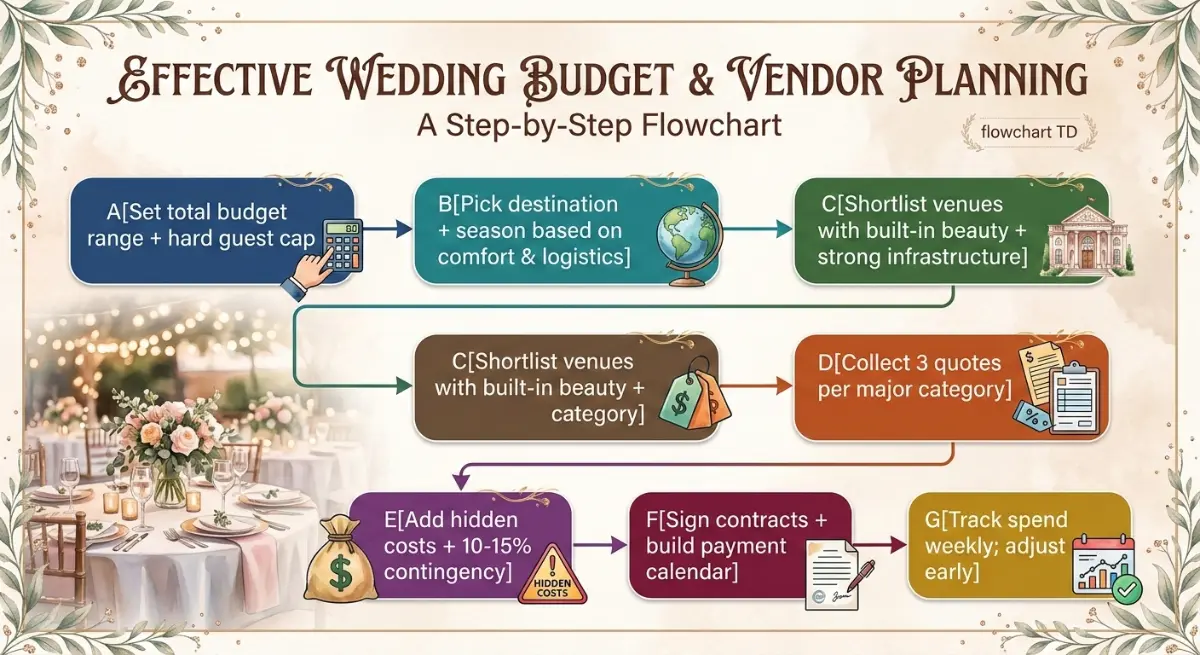
(Framework based on standard budgeting logic and vendor sequencing; travel pricing context informed by the cited airfare/hotel forecasts.)
How much should you spend on the venue and built-in setting?
If you want your event to look expensive without spending irresponsibly, your best friend is a venue that does half the visual work for free: architecture, views, gardens, coastline, heritage interiors, or a design-forward hotel with a naturally cinematic layout. Your original draft said this plainly; the upgrade is making it a budget rule: pay for “already beautiful,” then decorate lightly and precisely.
A destination venue also needs operational strength—loading access, power, rain plan options, vendor coordination experience, and staff who do events weekly (not once a year). When those basics are weak, you’ll buy them later at premium rates through rentals, generators, last-minute labor, and overtime.
Sample budget allocation table for a luxury destination event
Below is a practical baseline for a multi-day destination event (welcome + main event + farewell brunch) where you’re hosting like a grown-up. The percentage logic adapts from real-couple wedding vendor splits (venue/rentals and food/drink dominating; photography, florals/decor, transportation, and planning as consistent line items) while expanding hospitality + logistics for a destination context. Reference : Wedding Budget Breakdown, Based on Real Couples’ Data
| Budget category | Target % of total | Example on $150,000 | Example on $300,000 |
| Venue + site fees + core rentals | 25–35% | $37,500–$52,500 | $75,000–$105,000 |
| Food + beverage + service charges | 20–30% | $30,000–$45,000 | $60,000–$90,000 |
| Guest hospitality (welcome events, gifts, concierge touches) | 8–15% | $12,000–$22,500 | $24,000–$45,000 |
| Transportation (airport + event shuttles, logistics) | 5–10% | $7,500–$15,000 | $15,000–$30,000 |
| Design + production (florals, lighting, tabletop, drape, staging) | 10–18% | $15,000–$27,000 | $30,000–$54,000 |
| Photo/video/content capture | 5–10% | $7,500–$15,000 | $15,000–$30,000 |
| Entertainment + audio (band/DJ + sound quality) | 4–8% | $6,000–$12,000 | $12,000–$24,000 |
| Planning + on-site coordination | 6–12% | $9,000–$18,000 | $18,000–$36,000 |
| Contingency + insurance + compliance | 8–15% | $12,000–$22,500 | $24,000–$45,000 |
These are not “rules of nature.” They’re a map that reflects how real budgets typically weight the big-ticket drivers (venue, rentals, and catering/food/drink) and why destination events require heavier hospitality, transport, and contingency planning.
How do you budget for guest experience without wasting money?
Luxury isn’t a swag bag. It’s the feeling of being looked after.
The biggest destination mistake is spending hard on aesthetic moments while guests are sweating through logistics: confusing arrivals, no clear transport, long waits to check in, no water anywhere, and a schedule that assumes everyone knows the plan by telepathy. Your original article is right to prioritize hospitality; the improvement is defining what hospitality is in costed line items.
Spend where guests feel it:
- Arrival clarity: pre-event email + WhatsApp concierge number + simple itinerary.
- Transportation reliability: one point of control (shuttle captain or transport coordinator).
- Welcome runway: first drink, first snack, first “you’re in the right place” moment within 10 minutes.
- Comfort infrastructure: shade/heat solutions, hydration stations, restrooms, seating, and pacing.
Experience scenario that works
A 3-day coastal destination celebration budgeted $280,000 for ~65 guests. The host team chose a venue with dramatic natural scenery and strong on-site staff (higher site fee, cheaper décor), shifted $12,000 out of florals into $12,000 of lighting + audio polish, and added $18,000 for seamless airport-to-hotel-to-event shuttles (including a backup vehicle and a transport lead). Result: guests talked about how “easy” everything felt—and ease is a luxury signal. (Illustrative scenario: numbers represent a realistic tradeoff pattern, not a specific identifiable client event.)
What design spend actually reads as “luxury” in photos and in-person?
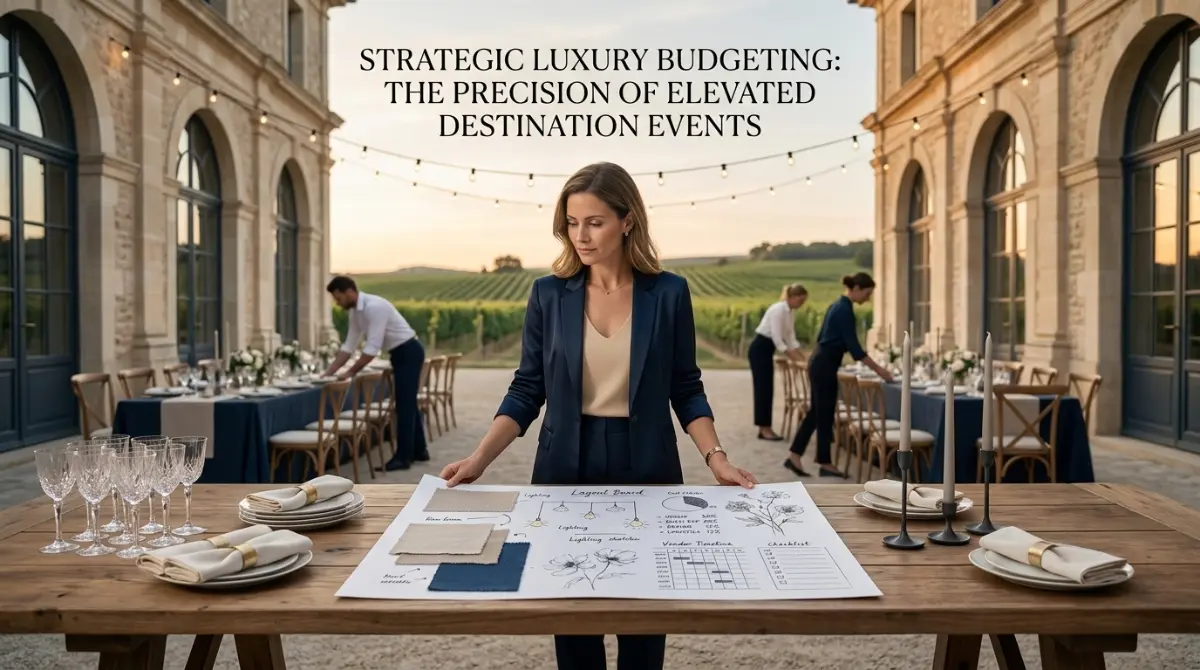
Design is where people overspend emotionally. It’s also where smart hosts can win. Working with professionals experienced in luxury event planning ensures that each detail supports the overall vision.
Use a “luxury signal” filter: If this disappeared, would guests notice within 5 minutes?
High-impact design tends to be:
- Lighting (warmth, depth, night mood)
- Sound (people can actually talk at dinner; music hits clean)
- Textiles and tabletop (tactile quality is perceived quality)
- Intentional negative space (not cluttered; editorial, not chaotic)
Also: destination events can’t depend on “we’ll just bring it in.” Shipping, customs delays, festival season shortages, local labor rules—these aren’t edge cases. They’re common reasons budgets wobble. Travel and capacity constraints are explicitly discussed in both airfare outlooks and broader travel economics reporting, so build your design plan assuming constraints, not best-case magic. Reference: https://www.iata.org/en/iata-repository/publications/economic-reports/global-outlook-for-air-transport-december-2025/
“Hidden costs” table you should budget from day one
| Hidden cost category | Why it surprises people | Typical planning allowance |
| Service charges + staffing minimums | “Per person” quotes often exclude mandatory service fees | Add 20–30% buffer to F&B quotes |
| Vendor travel + lodging + per diems | Destination talent often requires multi-day travel | 3–10% of total budget (more if importing a full team) |
| Customs, shipping, and local sourcing gaps | Rentals/florals/props may need transport or substitution | $1,000–$15,000+ depending on complexity |
| Weather backup (tents, flooring, heaters/fans) | Outdoor plans without a funded Plan B are fantasy | $8,000–$50,000+ |
| Permits, curfews, sound ordinances, security | Rules differ widely by destination and venue type | $500–$10,000+ |
| Currency + payment fees | FX swings and card/wire fees add friction | 2–4% buffer on international payments |
| Insurance | Some venues require specific policies and limits | $500–$5,000+ |
Airlines and hotels openly forecast cost pressures and modest price increases in many markets—so buffers are not pessimism; they’re competence.
Why coordination and contingency are your ROI line items
Luxury is when nothing looks hard.
Destination events are logistics-heavy: multiple vendors, different languages and business norms, transport timing, weather, curfews, and contracts that must align. Your original article frames coordination as “peace of mind.” True—and the E‑E‑A‑T upgrade is stating the financial reality: coordination prevents expensive mistakes (overtime, missed deliveries, wrong setup, rushed rentals).
Failure scenario that teaches the lesson fast
A couple planned a destination weekend at $200,000 for ~90 guests and chose a visually stunning but operationally weak venue (limited power, no load-in plan, strict noise cutoff). They hired minimal coordination to save money. When weather turned, they needed a tent, generators, additional security, and last-minute rentals—adding $58,000 in four weeks. They didn’t just spend more; they spent more badly, under stress, with fewer choices. (Illustrative scenario based on common destination failure modes.)
Contingency is not a “miscellaneous” line. Treat it like a required system.
If sustainability and local impact matter to you, point your planning toward recognized frameworks like ISO 20121 and the Event Industry Council’s sustainable event standards; this strengthens trust with guests and partners, and it pushes your vendor decisions toward documented practices instead of vibes.
Expert checklist for a seamless destination budget
Use this like a pre-contract gate. If you can’t check these off, pause signing.
1) You have a real guest cap (and you’re willing to enforce it).
2) You chose a venue with infrastructure (power, access, staff, weather options).
3) You priced travel reality into the plan (rooms, transport, vendor travel).
4) You funded atmosphere, not clutter (lighting + audio before décor bloat).
5) You budgeted hidden costs explicitly (service charges, permits, weather Plan B).
6) You built a payment calendar that matches your cash flow (deposits are timing risk).
7) You reserved contingency upfront (aim 10–15% for destination complexity).
FAQ
How much should you spend on the venue?
Plan about 25–35% of the total budget for venue + core site fees/rentals if you want a “built-in wow” setting that reduces décor spend. Use it as a starting range, then adjust based on what’s included.
What’s the smartest place to “splurge” for luxury impact?
Splurge on guest comfort + flow (transport, staffing) and atmosphere (lighting and audio). These are the levers guests feel immediately.
How much contingency do I really need?
For destination events, 10–15% is a practical target because travel and supply variables can shift quickly, and weather backup can be expensive.
Are airfare and hotel costs expected to keep rising?
Forecasts point to mostly stable-to-modest airfare change in 2026 with underlying cost pressures, while many hotel markets still show modest rate growth—so plan for “not cheaper,” especially in peak periods.
How do I avoid paying for décor twice?
Choose a venue with natural visual strength, then design with restraint. If you must build structure (tents, staging, heavy rentals), budget it early and compare venues again—structure costs can erase the “deal.”
How do I make the event feel local and not touristy?
Use local food cues, regional music textures, and culturally respectful timing and vendors. If sustainability is a goal, align with recognized event sustainability frameworks instead of improvising.
