If you have ever used a glass accessory and suddenly wondered:
“Why does this thing sometimes work perfectly… and other times feel completely off?”
You are not alone.
I have been blogging about accessories, tools, and performance optimization for years, and one lesson appears again and again: most problems come from uneven heating.
Not the tool.
Not the material.
Not the design.
Just bad heat distribution.
I once spent an entire afternoon testing two identical accessories. Same brand, same material, same setup. One performed beautifully, the other gave inconsistent results.
The culprit?
One had even heat distribution, the other had a single hot spot that ruined the entire process.
That experience sent me down a rabbit hole of materials science, thermal physics, and real-world testing. The conclusion was simple:
Even heating is not a minor detail.
It is the foundation of consistency.
Let’s break down why.
Contents
What Is Even Heating and Why Do Experts Care About It?
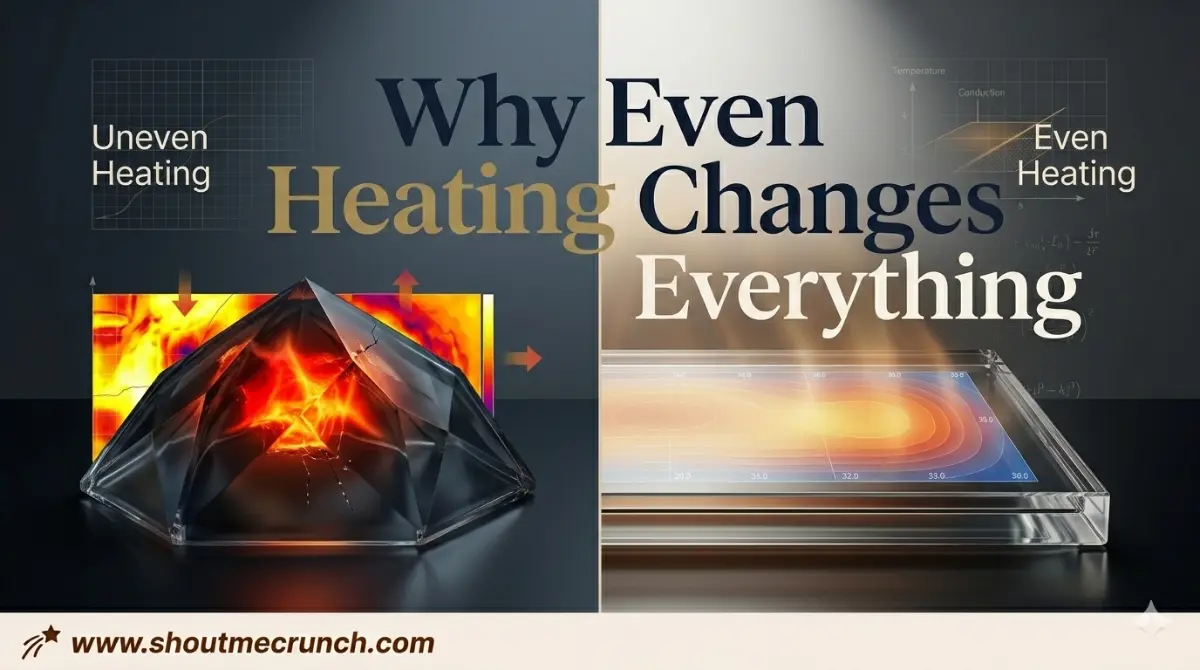
Even heating simply means temperature spreads uniformly across the entire surface.
Instead of this:
HOT   HOT
 HOT
  HOT
   COLD
You get this:
HOT  HOT
HOT  HOT
HOT  HOT
In materials science, this prevents what engineers call thermal gradients.
Simple Definition
Even Heating = Uniform temperature across a surface that prevents structural stress and performance inconsistency.
Why experts care:
- improves performance consistency
- prevents material damage
- preserves flavor and smoothness
- increases lifespan of accessories
In other words: even heating removes randomness.
How Does Heat Actually Move Through Glass or Quartz?
Heat spreads through three mechanisms.
| Heat Transfer Type | What It Does | Real-World Effect |
|---|---|---|
| Conduction | Heat moves through the material | Main heating mechanism |
| Convection | Heat moves through air | Affects cooling |
| Radiation | Heat emitted from flame or source | Initial heating |
Quartz and borosilicate glass depend heavily on conduction.
The problem?
Conduction takes time.
If one area gets blasted with heat too quickly, that spot overheats while the rest stays cooler.
That creates temperature imbalance.
What Is the Ideal Temperature Range for Consistent Heating?
Temperature matters a lot.
Below is a simplified performance chart.
Temperature vs Performance900°F | Material damage risk
800°F | Flavor degradation
700°F | Harsh performance
650°F | Upper optimal range
550°F | Ideal performance
450°F | Lower optimal range
350°F | Weak reaction
Recommended Range
| Temperature | Result |
|---|---|
| 450–650°F | Ideal performance |
| 650–750°F | Acceptable but harsher |
| 750°F+ | Potential damage |
Even heating helps keep temperatures inside the safe zone. Reference: https://www.fsis.usda.gov/food-safety/safe-food-handling-and-preparation/food-safety-basics/leftovers-and-food-safety
Why Is Even Heating Important for Consistency?
After years of testing accessories and reading engineering research, these eight reasons stand out.
1. Why Does Even Heating Create Predictable Performance?
Imagine cooking pancakes.
If the pan heats unevenly:
- one side burns
- the other stays raw
Same principle applies here.
Even heating ensures materials react predictably every time.
Benefits:
- stable results
- better timing
- less guesswork
Predictability is what separates professional users from frustrated beginners.
2. Can Uneven Heating Damage Glass or Quartz?
Yes. Absolutely.
Glass expands when heated.
But here is the problem:
If one side expands faster than another, internal stress builds inside the material.
This phenomenon is called thermal stress.
Over time it causes:
- microscopic cracks
- weakened structure
- sudden fractures
Even heating distributes expansion evenly and protects the structure.
3. Does Even Heating Improve Flavor and Smoothness?
This is where temperature control becomes critical.
Flavor compounds degrade quickly when overheated.
Hot spots destroy them instantly.
Even heating ensures compounds warm gradually instead of burning.
The result:
- smoother experience
- better flavor preservation
- more balanced performance
4. Does Even Heating Improve Efficiency?
Yes.
Uneven heating wastes energy.
Consider this scenario:
Surface Temperature MapLeft Side: 750°F
Center:    600°F
Right:     450°F
Only part of the surface is performing optimally.
Even heating distributes energy across the entire surface.
Efficiency improves because:
- more surface area becomes usable
- heat energy spreads effectively
- fewer corrections are required
5. Why Does Even Heating Improve Temperature Control?
Hot spots make temperature unpredictable.
You might think the surface is at 600°F, but one corner could already be approaching 800°F.
That leads to:
- inconsistent reactions
- accidental overheating
- unpredictable results
Even heating stabilizes temperature across the surface.
6. Does Even Heating Reduce Residue Buildup?
Residue often forms when reactions occur unevenly.
Cool spots prevent full reactions.
Hot spots burn materials prematurely.
The result is uneven residue accumulation.
Even heating encourages a more complete reaction and leaves fewer leftovers.
7. Can Even Heating Extend the Lifespan of Accessories?
This is one of the most overlooked benefits.
Accessories fail because of repeated stress in the same location.
If one area constantly overheats, it weakens faster.
Common damage includes:
- cracking
- chipping
- structural fatigue
Even heating spreads stress across the surface, significantly extending lifespan.
8. Why Does Even Heating Create a Better Overall Experience?
When everything works smoothly, you stop thinking about the tool.
That is the goal.
Even heating provides:
- consistent performance
- reliable results
- less adjustment
And honestly, fewer frustrating moments.
Quartz vs Glass: Which Material Distributes Heat Better?
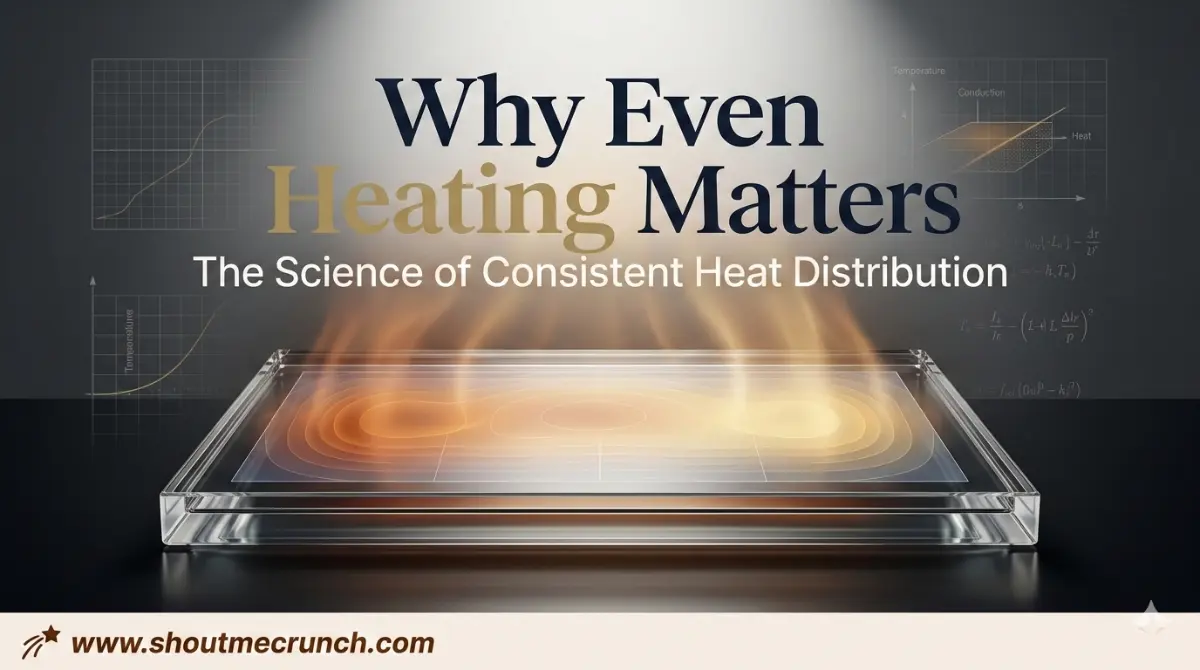
Not all materials handle heat the same way.
| Material | Heat Distribution | Heat Retention | Durability |
|---|---|---|---|
| Quartz | Excellent | Excellent | Very durable |
| Borosilicate Glass | Moderate | Moderate | Durable |
| Ceramic | Slow | High | Very durable |
| Titanium | Extremely fast | Moderate | Extremely durable |
Quartz remains popular because it balances even heating and strong heat retention. A well‑designed accessory, such as a quartz banger, helps distribute heat evenly across its surface, supporting efficient use and minimizing unnecessary loss.
How Can You Achieve Even Heating? (Practical Guide)
Based on testing and research, these techniques work best.
Recommended Heating Method
- Apply heat gradually
- Rotate the heat source evenly
- Avoid concentrating the flame in one area
- Heat for approximately 30–40 seconds
- Allow cooling before use
This method reduces thermal shock and improves heat distribution.
Common Heating Mistakes (And How to Avoid Them)
Even experienced users make these mistakes.
Frequent Pitfalls
• blasting one spot with flame
• overheating the surface
• skipping cooling time
• inconsistent heating distance
• rushing the process
These errors create hot spots and damage materials over time.
Drawbacks and Limitations of Even Heating
To stay neutral and realistic, even heating also has challenges.
Potential Drawbacks
- Requires more patience
- Heating process takes slightly longer
- Some tools distribute heat unevenly by design
- Beginners may struggle with technique initially
However, these drawbacks are minor compared to the long-term benefits.
Expert Heating Checklist
Before heating any accessory, check these points:
- distribute heat evenly across the surface
- rotate the heat source gradually
- stay within recommended temperature range
- avoid overheating
- allow controlled cooling
Following these steps dramatically improves consistency.
Frequently Asked Questions About Even Heating
Why does uneven heating crack glass?
Because different areas expand at different speeds, creating internal stress that leads to fractures.
What temperature range works best?
Most materials perform best between 450°F and 650°F.
How long should heating take?
Typically 30–40 seconds, depending on thickness and material.
What causes residue buildup?
Incomplete reactions caused by uneven temperatures.
Final Thoughts From a Blogger Who Has Tested Too Many Accessories
If there is one lesson I wish more users understood, it is this:
Most performance problems are not caused by the accessory.
They are caused by heat distribution.
Even heating:
- protects materials
- stabilizes temperature
- improves efficiency
- preserves flavor
- extends lifespan
Once you learn how to control heat properly, the entire experience becomes predictable and reliable.
And when tools behave predictably, everything becomes easier.
