An in-depth, data-driven analysis of the hybrid healthcare model shaping our future
A few months ago, a diabetic mother named Rahima from a small village in Rangpur told her doctor something that stuck with me:
“I used to spend an entire day traveling just to show my glucose report. Now I press one button on my phone.”
That single sentence captures the shift happening worldwide.
Healthcare is moving—fast—toward a digital-first model.
Virtual consultations, online prescriptions, AI triage, remote monitoring devices, telehealth billing, and digital workflows are no longer “innovations.” They’re infrastructure.
Yet, as advanced as digital care becomes, one truth remains unshakeable:
Healthcare will never be 100% online.
There will always be a place for the human touch—the physical exam, the reassuring presence, the in-clinic diagnosis. This shift has opened new possibilities for rural communities, busy families and those with limited mobility.
This article explores why, drawing on global statistics, expert insights, and the evolving landscape of hybrid healthcare systems.
Contents
A Global Shift Toward Digital-First Healthcare
Digital healthcare is not just a trend—it is a transformation. According to McKinsey (2024):
- 60–70% of all routine care could be delivered digitally.
- Telehealth adoption increased 38× during COVID-19.
- Hybrid-care systems are improving patient satisfaction by 45%+.
The shift is driven by a combination of technology, convenience, and necessity.
1. Barriers of distance are disappearing
Digital care has unlocked access for:
- Rural communities
- Elderly or mobility-impaired patients
- Busy professionals
- Patients with chronic conditions requiring frequent follow-up
2. Providers are benefiting too
Doctors and clinics report:
- Reduced administrative pressure
- Faster communication
- Better scheduling
- Improved continuity of care
- Better data coordination across facilities
As WHO noted in 2023:
Digital health is now considered a foundational pillar of universal health coverage.
But as beneficial as digital tools are, they cannot—and should not—replace everything.
Why Healthcare Will Never Be Entirely Digital
Even with video calls and AI-driven care, some aspects of medicine are deeply human and inherently physical.
1. Physical examination cannot be digitised
Certain assessments require:
- Palpation
- Auscultation
- Diagnostics
- Imaging
- Emergency care
- Minor procedures
No camera can replace a stethoscope—or a surgeon.
2. Emotional and psychological comfort
When delivering difficult diagnoses, guiding patients through illness, or supporting mental health crises…
face-to-face presence matters.
Stanford Medicine (2023) notes:
Patients are 68% more emotionally receptive in in-person consultations.
3. Limitations of technology
Not all patients have:
- Stable internet
- Digital literacy
- Private spaces for consultation
Thus, hybrid care—not digital-only—is the true future.
The Hybrid Future: A Blended Model of Care
The future healthcare system will revolve around flexibility and choice.
Patients will move between digital and in-person care depending on their needs.
Here’s a comparison:
Table 1 — Digital vs. In-Person Care
| Type of Care | Best For | Not Suitable For |
| Digital Consultations | Follow-ups, chronic care, mental health, medication refills | Physical exams, emergencies |
| Remote Monitoring | Diabetes, cardiac issues, hypertension | Acute crisis episodes |
| In-Person Visits | Diagnostics, surgery, complex evaluation | Travel barriers, high wait times |
| Hybrid | Most modern clinics: triage online + exam offline | — |
Technology & Billing: The Hidden Engine Behind Digital Healthcare
Most people never see the machinery powering telehealth behind the scenes—but it’s immense. Providers are adopting telehealth billing strategies that make it easier to handle online payments, insurance processes and remote consultations.
Digital billing systems have become the backbone of virtual care workflows.
How digital billing improves care:
- Automated insurance claims
- Instant payment verification
- Transparent, itemized billing
- Faster provider reimbursement
- Reduced errors and fraud
- Seamless integration with EHR
Clinics adopting telehealth billing see a 32% improvement in revenue cycle efficiency.
When billing is easy, patients use virtual care more confidently.
When billing is difficult, frustration rises—and adoption drops.
The Technologies Powering the Digital Surge
Digital healthcare is far more than video calls. Here are the key enablers shaping the next decade:
1. Artificial Intelligence (AI)
- Symptom triage
- Early disease detection
- Drug interaction alerts
- Automated follow-up reminders
- Predictive analytics
2. Internet of Medical Things (IoMT)
Wearable & home-based devices:
- Glucose sensors
- Blood pressure monitors
- ECG patches
- Sleep trackers
- Smart inhalers
They allow physicians to monitor patients in real-time.
3. Electronic Health Record (EHR) Interoperability
FHIR, HL7, and national health data standards enable:
- Cross-hospital data syncing
- Instant sharing of patient history
- Unified prescriptions and test reports
4. Digital therapeutics (DTx)
Clinical-grade apps now treat:
- ADHD
- Diabetes
- Depression
- Anxiety
- Chronic pain
5. Virtual hospitals
Countries like the UK and Australia already run virtual wards—patients recover at home while monitored digitally.
Data Security & Trust: The Non-Negotiable Requirement
Digital health cannot thrive without trust.
That means safeguarding:
- Clinical data
- Payment information
- Consent documentation
- Telehealth platform security
Key global regulations:
- HIPAA (USA)
- GDPR (EU)
- Australia Privacy Act
- Bangladesh National Digital Health Strategy & Data Protection Guidelines
Healthcare breaches cost an average of $10.9 million per incident (IBM 2024).
Patients will not adopt digital care without guaranteed safety.
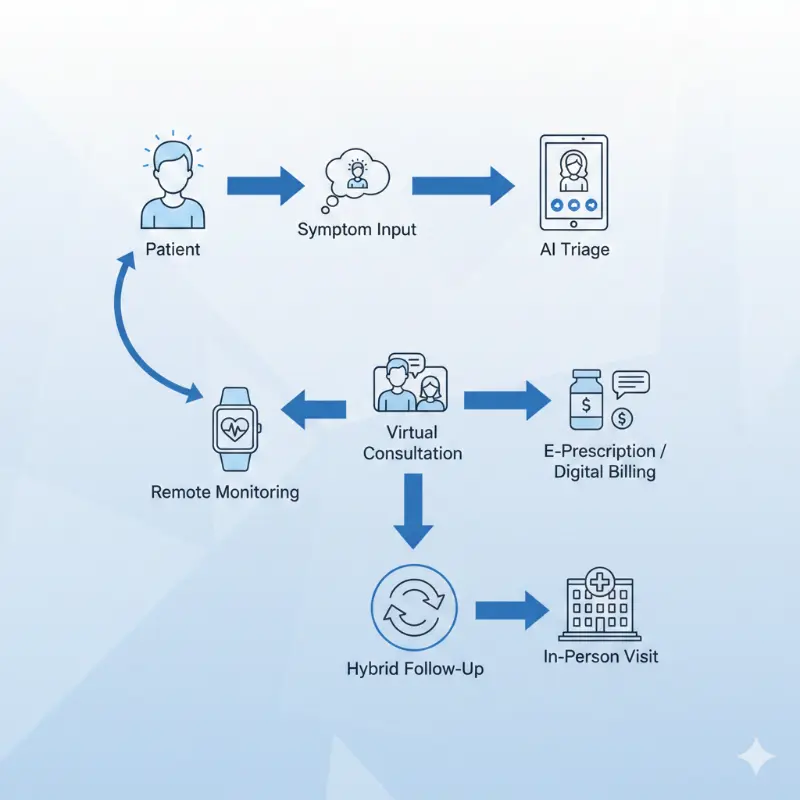
The Digital Healthcare Workflow Diagram
Future Trends That Will Define the Next 10 Years
1. Predictive healthcare
AI will identify risks before symptoms appear.
2. Personalized treatment using genomics
Precision medicine integrated with digital platforms.
3. Home-based diagnostics
Portable ultrasound, home lab kits, AI imaging analysis.
4. Blockchain medical records
Tamper-proof, patient-owned health data.
5. Healthcare decentralization
Small clinics, pharmacies, and even home care will be digitally connected to national systems.
6. Virtual care becoming a permanent benefit
Insurers worldwide are now adding telehealth as a standard coverage item—no longer temporary.
Why Digital Healthcare Strengthens—Not Replaces—Traditional Care
The narrative has shifted. Digital healthcare isn’t replacing traditional medicine.
Digital healthcare is not a competitor to clinics.
It is an expansion of what’s possible.
This blended model:
- Reduces wait times
- Increases access
- Improves chronic care outcomes
- Supports rural health
- Enhances patient satisfaction
- Frees doctors for complex cases
As Mayo Clinic stated in 2024:
“The future of medicine is hybrid—digital care where possible, human care where necessary.”
Actionable Insights for Healthcare Leaders
1. Invest in digital-first triage
Reduces unnecessary clinic visits by 30–40%.
2. Adopt unified billing + EHR systems
Eliminates friction, boosts trust.
3. Build hybrid-care pathways
Patients expect flexibility.
4. Strengthen cybersecurity architecture
Essential for long-term sustainability.
5. Train staff in digital literacy
Technology is only effective if people can use it well.
Table 2 — What Patients Prefer (Survey Summary)
Based on aggregated insights from Deloitte, WHO, and Accenture
| Care Type | Preference Level | Reason |
| Virtual for follow-ups | 72% | Convenience, travel saved |
| In-person for diagnosis | 89% | Accuracy, reassurance |
| Digital prescription renewals | 81% | Speed |
| Hybrid chronic disease care | 67% | Monitoring + human support |
| Fully digital-only healthcare | 12% | Trust & limitations |
FAQ
1. Will digital healthcare replace hospitals?
No. Digital care expands access but cannot replace physical exams, diagnostics, or surgeries. Hybrid care will dominate instead.
2. Are telehealth services secure?
Yes—when providers use HIPAA/GDPR-compliant platforms with encrypted data and secure billing systems.
3. What conditions are best suited for virtual care?
Chronic diseases, mental health, dermatology, routine check-ins, and post-operative follow-up.
4. Do digital visits cost less?
Often yes. Lower overhead allows clinics to reduce charges, and digital billing reduces administrative fees.
5. What technology will shape the next decade?
AI triage, remote monitoring, digital therapeutics, interoperable EHRs, and predictive health analytics.
Conclusion: The Future Is Hybrid—and Human
Digital healthcare has rewritten how people access care, how doctors deliver it, and how health systems operate. But no matter how advanced technology becomes, it cannot replace:
- Human empathy
- Physical diagnosis
- Real-world medical expertise
- The comfort of face-to-face care
Instead, digital healthcare makes traditional care stronger, smarter, and more accessible.
The future is not online vs. offline.
It is online + offline, seamlessly connected—
a system that adapts to modern life while keeping human connection at the heart of every interaction.
