Bangladesh is rapidly moving toward a digitally integrated healthcare ecosystem, and one of the most transformative initiatives in this journey is Health ID Bangladesh. Introduced by the Ministry of Health and Family Welfare (MOHFW) and implemented through the Management Information System (MIS) of the Directorate General of Health Services (DGHS), the Health ID aims to provide every citizen with a unique digital identity for healthcare services.
This initiative addresses a long-standing challenge in Bangladesh’s healthcare system: fragmented patient identification across different health facilities and databases. By assigning a single health identity from birth, Bangladesh aims to ensure that medical records, vaccination history, maternal health services, and treatment data can be connected securely across the healthcare system.
With a population exceeding 170 million people, establishing a unified digital health identity is not just an administrative improvement—it is a critical infrastructure for the future of healthcare delivery, disease surveillance, and health policy planning in Bangladesh.
Contents
What is Health ID Bangladesh?
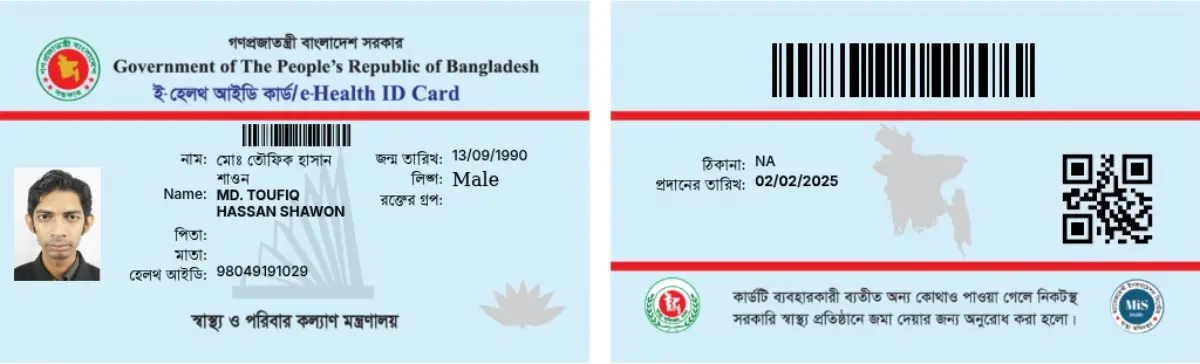
Health ID Bangladesh is a unique digital identifier assigned to individuals to track and manage their healthcare interactions across hospitals, clinics, and national health programs.
The system allows individuals to maintain a centralized digital health profile, which can include:
- Medical encounters
- Vaccination records
- Maternal health services
- Child health monitoring
- Diagnostic history
- Treatment records
Unlike traditional identification systems, the Health ID is specifically designed for healthcare interoperability, ensuring that patient records can follow the individual across different health facilities.
Why Bangladesh Needs a Health ID
Bangladesh currently operates with two primary identification systems:
- National Identity Card (NID) issued by the Election Commission
- Birth Registration Number (BRN) issued by the Office of the Registrar General
While both serve important administrative purposes, neither was designed specifically for healthcare service delivery.
Key Limitations of Existing IDs
| Identification System | Authority | Limitations for Health Services |
|---|---|---|
| National ID (NID) | Bangladesh Election Commission | Issued only after age 18 |
| Birth Registration (BRN) | Office of the Registrar General | Not universally obtained immediately after birth |
| Health ID | MOHFW / DGHS | Designed for healthcare services from birth |
Healthcare systems require identification from the earliest stages of life, often even before birth through maternal antenatal care (ANC) services.
Because of this, the health sector is usually the first government system to capture an individual’s identity, beginning with:
- Maternal care
- Delivery events
- Child vaccination
- Early childhood health monitoring
This makes the health system uniquely positioned to initiate a lifelong digital identity for healthcare purposes.
The Digital Health Identity Ecosystem
Health ID is envisioned as a foundational layer connecting multiple government systems.
Conceptual Identity Flow
Maternal ANC Registration
        ↓
Child Birth Event (Health System)
        ↓
Health ID Creation
        ↓
Birth Registration Number (BRN)
        ↓
National Identity Card (NID)
In this model, Health ID becomes the earliest digital identity created for an individual, later linking with BRN and eventually NID.
This approach supports the development of a complete life-cycle health record.
Objectives of Health ID Bangladesh
The Health ID initiative is designed to achieve several strategic goals within Bangladesh’s digital health transformation.
Core Objectives
- Unique identification of patients across health facilities
- Centralized digital health records
- Improved healthcare service delivery
- Better disease surveillance and epidemiological monitoring
- Enhanced health data for policy planning
Expected National Impact
| Impact Area | Expected Outcome |
|---|---|
| Healthcare access | Faster patient registration |
| Medical history | Continuity of care across hospitals |
| Vaccination programs | Accurate coverage tracking |
| Public health policy | Better evidence-based decisions |
| Health research | Reliable population health data |
Health ID Registration System
The Government of Bangladesh has launched an online platform for Health ID registration:
Official Portal: https://amarswasthyo.mohfw.gov.bd
The platform allows citizens to create and manage their digital health identity online.
Step-by-Step Guide to Register Health ID
Registering for Health ID Bangladesh is a straightforward process.
Step 1: Visit the Official Portal
https://amarswasthyo.mohfw.gov.bd
Open the registration website: https://amarswasthyo.mohfw.gov.bd
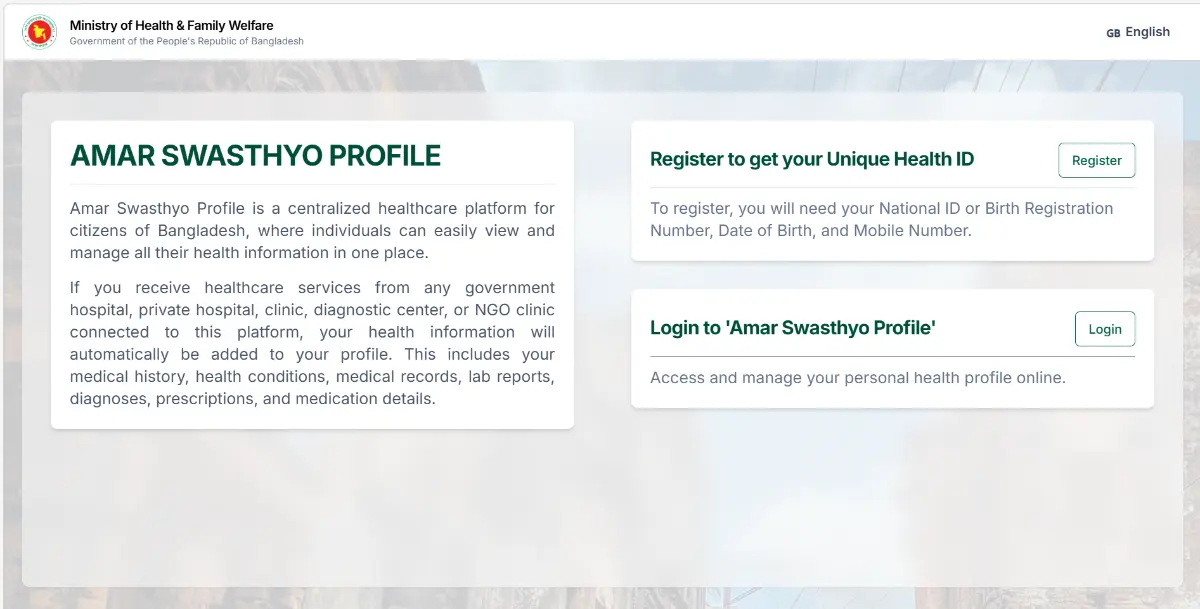
Step 2: Mobile Number Verification
Users must first verify their mobile number through an OTP (One Time Password) sent via SMS.
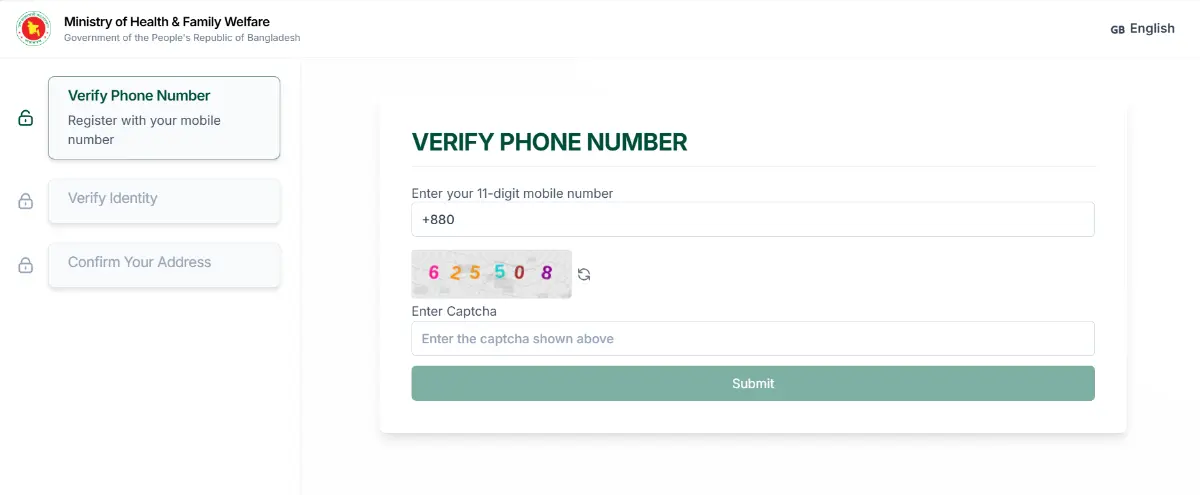
This step ensures secure authentication.
Step 3: Choose Identification Method
The system requires different identification documents based on age.
| Age Group | Required Identification |
|---|---|
| 18 years and above | National ID (NID) |
| Below 18 years | Birth Registration Number (BRN) |
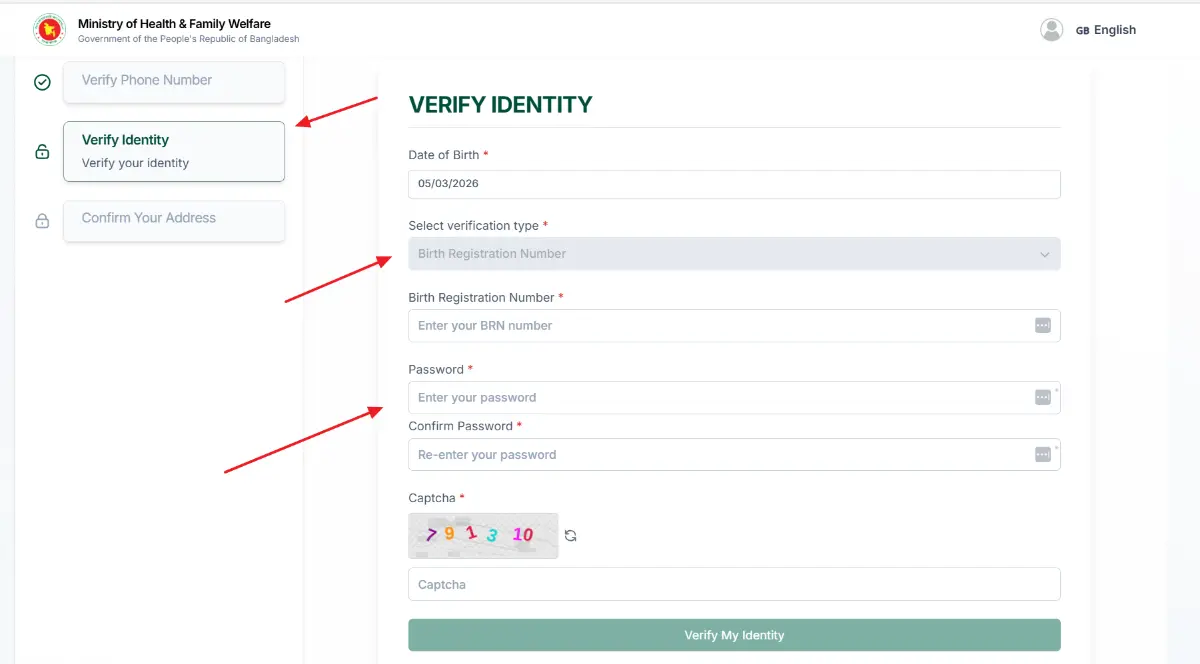
Step 4: Provide Personal Information
Users must enter personal information exactly as it appears in official documents.
For NID-based registration:
- Name in English
- Father’s name in Bengali
- Mother’s name in Bengali
The information must match the data stored in the Election Commission database.
Step 5: Upload Photograph (Non mandatory)
A passport-size photograph must be uploaded to complete the profile.
This image will be used for future verification and login access.
Step 6: Generate Health ID
Once registration is completed, the system generates a unique Health ID number linked to the individual’s health profile.
Viewing Your Health Profile
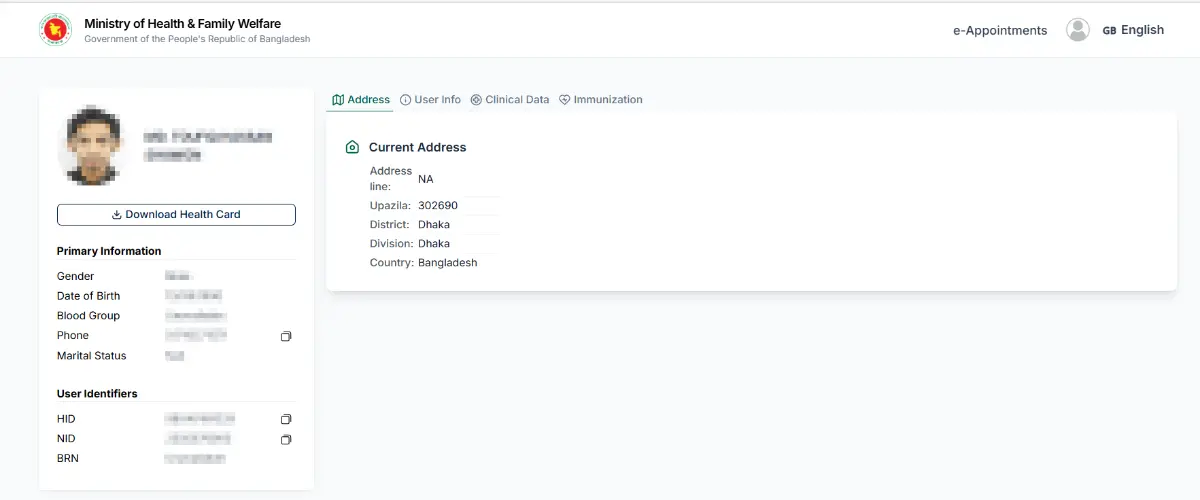
Individuals who have previously received services from DGHS healthcare facilities may already have medical interactions recorded in the system.
These appear as:
- Health encounters
- Service events
- Treatment records
This allows citizens to review their healthcare history in a centralized digital profile.
Benefits of Health ID for Citizens
The Health ID system offers multiple advantages for both individuals and healthcare providers.
Key Benefits
Unified Medical History
Health records can be stored in one place, improving continuity of care.
Faster Hospital Registration
Patients can be identified instantly without repeatedly providing personal information.
Improved Vaccination Tracking
Childhood and adult vaccination records can be easily tracked.
Better Maternal and Child Health Monitoring
Healthcare providers can track maternal services and child development.
Support for Telemedicine
Digital identity enables future telemedicine services and remote healthcare.
Major Challenges Facing Health ID Implementation
Despite its potential, several challenges must be addressed for the system to succeed.
1. NID Interoperability Limitations
The Election Commission’s NID system currently provides limited data access.
Previously, NID verification APIs could return detailed personal information.
However, current systems often return only a binary Yes/No response, making interoperability more difficult.
This restricts real-time integration between government systems.
2. Low BRN Adoption in Early Childhood
Although BRN should legally be issued at birth, many children—especially those under five years old—do not immediately obtain birth registration.
Reasons include:
- Lack of awareness
- Administrative complexity
- Limited perceived need before school admission
This creates gaps in identity systems.
3. Duplicate Birth Registration Numbers
System loopholes have resulted in cases where individuals possess multiple BRNs.
This creates challenges for digital identity systems that depend on unique identifiers.
4. Fragmented Health Information Systems
Bangladesh’s healthcare ecosystem includes multiple digital platforms such as:
- DHIS2 health reporting system
- OpenSRP community health platform
- Hospital electronic medical record systems
- Smart Health BD initiatives
Without a unified identity system, integrating these systems becomes difficult.
Health ID aims to solve this challenge.
Future Vision of Health ID Bangladesh
Health ID has the potential to become the backbone of Bangladesh’s digital health infrastructure.
Future Capabilities
- Nationwide electronic health records
- AI-driven disease surveillance
- Universal vaccination tracking
- Family health tree systems
- Digital health insurance
- National telemedicine platforms
A unified health identity can dramatically improve healthcare accessibility, efficiency, and policy planning.
Data Privacy and Security
Handling health data requires strong privacy protections.
Health ID systems must ensure:
- Secure authentication
- Controlled access for healthcare providers
- Protection against unauthorized data access
- Compliance with national data protection policies
The system must balance data accessibility for healthcare services with patient privacy protection.
Frequently Asked Questions
Is Health ID mandatory in Bangladesh?
Currently, Health ID is not mandatory but is expected to become increasingly important as digital health services expand.
Can children get a Health ID?
Yes. Children under 18 can register using their Birth Registration Number (BRN).
Can Health ID replace NID?
No. Health ID is designed specifically for healthcare services and complements existing identification systems.
Is Health ID linked to hospitals?
Health ID can connect healthcare interactions across government healthcare facilities and programs.
Expert References
The concept of national health identity systems is widely recognized in global digital health strategies.
Key references include:
World Health Organization (WHO)
Digital Health Strategy 2020-2025: https://www.who.int/publications/i/item/9789240020924
World Bank
Digital Identification Systems for Health: https://documents.worldbank.org
Bangladesh Ministry of Health and Family Welfare
Digital Health Transformation Initiatives: https://mohfw.gov.bd
Conclusion
The Health ID Bangladesh initiative represents a critical step toward building a modern, interoperable digital healthcare system.
By assigning a unique health identifier to every citizen, Bangladesh can ensure that medical records, vaccination history, and treatment data follow individuals throughout their lives.
If implemented effectively, Health ID will strengthen healthcare delivery, improve policy planning, and support the country’s long-term vision of a fully integrated digital health ecosystem.
For a nation of more than 170 million people, the success of Health ID could become one of the most important foundations of Bangladesh’s future healthcare infrastructure.
Funny thing is the website name is difficult it can be pronunced as amarswasthyo, amar swasthyo, amar sastho, amar sashtho, amar shastho, amar swastho, amar shasto, amar shasthyo, amar sasthyo, amar sasto, amar sasth, amar shasth, amar swastha, amar shastha, amar swasth, amar স্বাস্থ্য, amar স্বাস্থ্য আইডি, amar shastho id, amar sastho id, amar swasthyo id
