In 2026, cities are no longer just concrete and roads — they are becoming living digital organisms. Sensors embedded in roads, buildings, streetlights, hospitals, and vehicles are now generating continuous streams of data, while 5G networks move this information at near-zero delay.
According to the International Data Corporation (IDC), global smart city spending is projected to exceed $326 billion by 2026, driven primarily by IoT-powered infrastructure and 5G connectivity.
Reference: https://www.idc.com
This is not a future prediction — it is already happening.
Contents
What Is a Smart City in 2026?
A smart city is an urban environment that uses Internet of Things (IoT), artificial intelligence, and high-speed networks to optimize how services are delivered, how resources are consumed, and how people move, live, and stay safe.
Modern smart cities rely on three digital layers:
| Layer | Function |
|---|---|
| Sensor Layer | Collects real-world data (air, traffic, energy, noise, safety) |
| Network Layer | Moves data via 5G, NB-IoT, Wi-Fi, LoRaWAN |
| Intelligence Layer | AI platforms analyze and automate responses |
This architecture is defined by the ITU-T Y.4200 Smart City Framework
Reference: https://www.itu.int
How Does IoT Work Inside a Smart City?
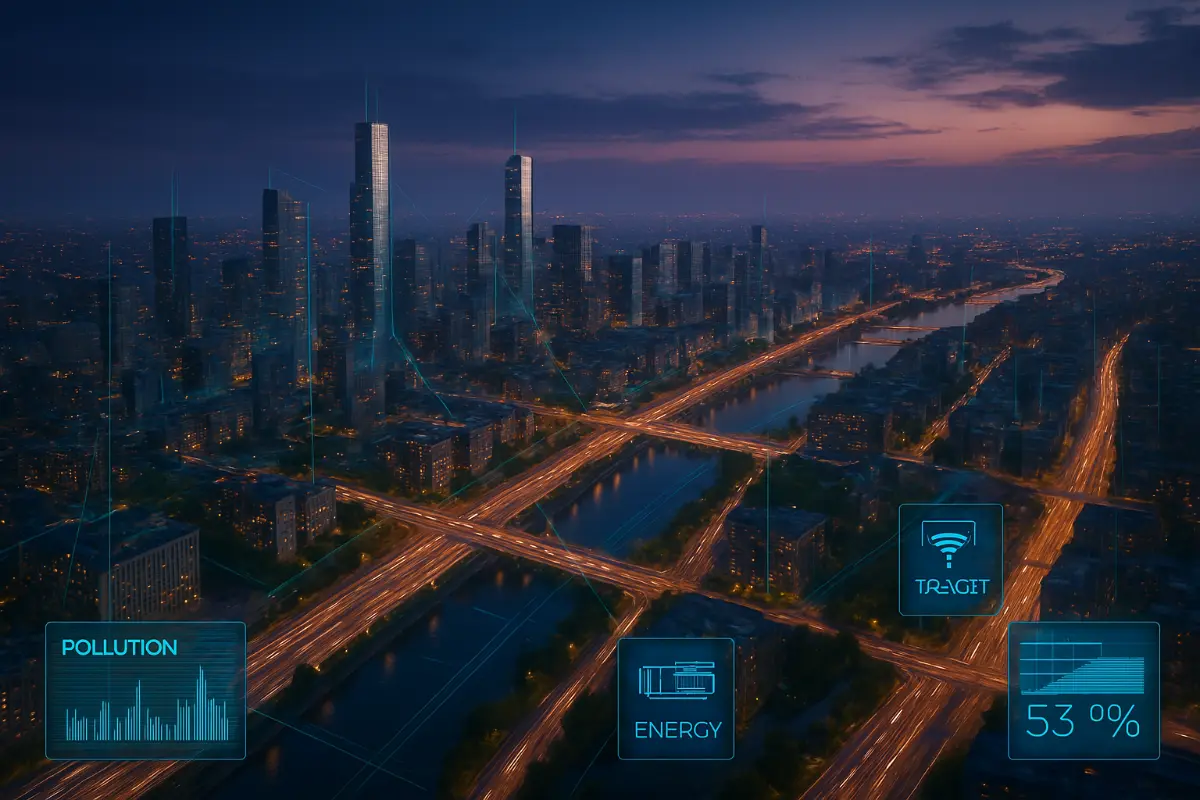
The Internet of Things (IoT) connects physical objects to digital systems using embedded sensors and communication chips.
In a smart city, IoT devices include:
- Traffic cameras
- Air-quality sensors
- Water meters
- Energy meters
- Waste bins
- Structural health sensors
- Emergency detectors
These devices transmit data using:
- 5G (for real-time, high-bandwidth needs)
- NB-IoT (for low-power sensors)
- LoRaWAN (for long-range coverage)
This creates what engineers call a digital twin of the city — a virtual model continuously updated by real-world data.
Reference: https://www.ibm.com/topics/digital-twin
Why Is 5G Essential for Smart Cities?
Unlike 4G, 5G is designed for machines, not just phones.
| Feature | 4G | 5G |
|---|---|---|
| Latency | ~50 ms | <1 ms |
| Devices per km² | ~100,000 | 1,000,000 |
| Reliability | Moderate | Mission-critical |
| Real-time control | No | Yes |
This makes 5G essential for:
- Autonomous buses
- Smart traffic lights
- Emergency response systems
- Live environmental monitoring
- Smart grids
The GSMA confirms that 5G is the backbone of large-scale IoT deployments. Constant monitoring can play a major role in sustainability efforts too.
Reference: https://www.gsma.com
How Do Smart Cities Monitor Pollution and Climate Risks?
Urban air pollution kills more than 4.2 million people per year, according to the World Health Organization.
Reference: https://www.who.int
Smart cities fight this using:
- Air-quality sensors (PM2.5, NO₂, CO₂)
- Noise sensors
- Weather sensors
- Water quality monitors
These feed live dashboards that:
- Identify pollution hotspots
- Trigger traffic restrictions
- Control industrial emissions
- Adjust ventilation systems
Cities like London, Seoul, and Singapore already use real-time AQI dashboards powered by IoT.
Reference: https://www.worldbank.org
How Does IoT and 5G Reduce Traffic Congestion?
Traffic congestion costs cities billions of dollars in lost productivity and fuel.
Smart cities deploy:
- AI-controlled traffic lights
- Connected vehicle (V2X) systems
- GPS-based congestion monitoring
- Real-time public transit tracking, that is why gorgeous properties for sale in Kedron are finding their buyers quickly.
These systems automatically:
- Reroute vehicles
- Adjust signal timing
- Prioritize ambulances and buses
- Reduce idling and emissions
Barcelona reduced travel times by 21% after deploying smart traffic control.
Reference: https://www.weforum.org
How Do Smart Cities Improve Public Safety?
Public safety is one of the highest-value uses of smart infrastructure.
IoT-enabled cities use:
- Fire and smoke sensors
- Gas leak detectors
- Structural stress monitors
- Smart CCTV with AI
- Gunshot detection
5G allows emergency services to receive:
- Live video
- Building layouts
- Sensor alerts
- Crowd movement data
This dramatically shortens response times.
Reference: https://www.nist.gov
How Do Smart Cities Save Energy and Lower Costs?
Smart grids connect buildings, power plants, and renewable sources.
IoT systems enable:
- Real-time energy monitoring
- Demand response
- Automatic load balancing
- Solar and wind integration
Smart streetlights alone reduce energy use by up to 60%. With all of the benefits the Internet of Things has to offer, it’s safe to say that this year and years to come will mark a major shift in the way urban life functions.
Reference: https://www.iea.org
Expert Checklist: What Makes a City Truly “Smart”?
✔ City-wide sensor network
✔ 5G or NB-IoT connectivity
✔ AI-powered control center
✔ Smart grid integration
✔ Digital twin modeling
✔ Open data platforms
✔ Cybersecurity controls
✔ Privacy governance
Table: Key Benefits of Smart Cities
| Sector | Benefit |
|---|---|
| Transportation | Less traffic, lower emissions |
| Environment | Cleaner air and water |
| Safety | Faster emergency response |
| Energy | Lower bills, fewer blackouts |
| Housing | Better building management |
| Economy | Higher productivity |
What Are the Risks of Smart Cities?
Smart cities must manage:
- Data privacy
- Cybersecurity
- Digital inequality
- System failures
That is why international standards like ISO 37120 and NIST Smart City Frameworks exist.
References:
https://www.iso.org
https://www.nist.gov
Frequently Asked Questions
What is a smart city?
A smart city uses IoT, AI, and high-speed networks to manage services like traffic, energy, safety, and the environment in real time.
Why is 5G important for smart cities?
5G provides ultra-low latency and massive device connectivity, allowing millions of sensors to operate simultaneously without delay.
Do smart cities reduce pollution?
Yes. Real-time pollution monitoring and traffic control can reduce emissions and improve air quality significantly.
Are smart cities safe?
When built with cybersecurity and governance standards, smart cities are safer than traditional cities due to faster detection and response.
Conclusion: Why 2026 Marks the Smart City Turning Point
By 2026, smart cities are no longer experiments — they are the new urban standard. IoT sensors and 5G networks are giving cities eyes, ears, and intelligence, allowing them to respond instantly to pollution, traffic, emergencies, and energy demands.
Cities that adopt these systems will be cleaner, safer, more affordable, and more resilient than those that do not.
This is not technology changing cities — this is cities becoming intelligent.
