
I had a dream that stayed with me for days.
Not the kind that lingers because it was frightening. The kind that lingers because it felt like something was being said, and I couldn’t shake the feeling that I was supposed to write it down.
In the dream, a handful of monks were scattered across the world. Not famous ones. Not leaders. Just a few people in different places, each carrying a staff. When danger approached, one of them would strike the ground. The earth carried the signal to the others. One signal was overwhelming — it moved through something the dream called the “zonal plane,” and its frequency was unbearable.
I’m not writing this to claim I received some prophecy. I’m writing this because the images kept arranging themselves into something coherent, and when I sat with them, they pointed at things that feel true about the world we’re living in.
Table of Contents
Why so few monks?
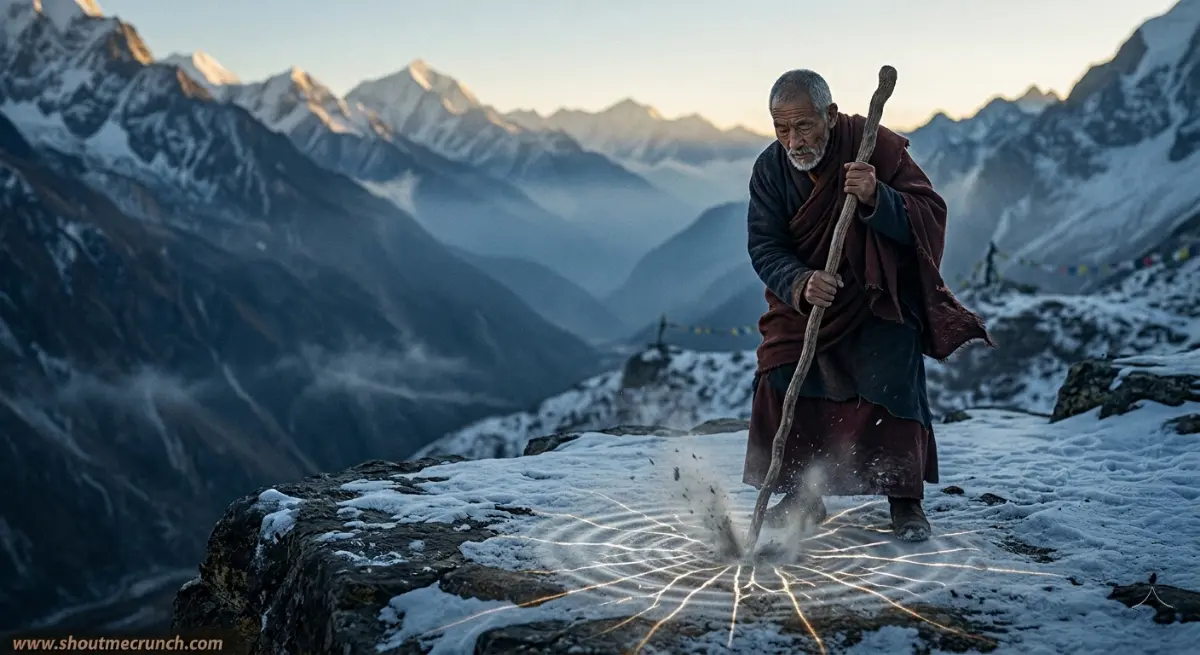
The monks were rare in the dream, and I think that detail matters.
The people who sense a civilization drifting before the majority does are always few. They might be scholars, believers, community elders, or just people who haven’t stopped paying attention. You see them in every society if you look — they’re the ones troubled by things others have already normalized. The ones who notice when a small dishonesty becomes policy, when a community’s language turns cold, when children grow up without anyone modeling patience.
They don’t rule anything. They don’t have large audiences. They carry staffs.
The staff, in almost every tradition that uses the image, means authority grounded in responsibility. A shepherd’s staff, a prophet’s staff, a pilgrim’s staff. You carry it because the path matters and the people walking it are your charge. Striking it to the ground means the warning is no longer theoretical. It has entered physical reality.
What is the “zonal plane”?
I’ve thought about this phrase a lot. It doesn’t come from any tradition I’m familiar with — it surfaced in the dream and I wrote it down.
My best reading of it: a layer where human choices accumulate before their consequences surface.
A single lie in an institution doesn’t collapse the institution. But a hundred lies over years, tolerated, promoted, never corrected — that builds pressure. A river isn’t destroyed by one factory’s runoff. Families don’t fracture from one argument. The pattern is always gradual accumulation followed by a threshold moment. The zonal plane, in my reading, is where the accumulation lives before the threshold arrives.
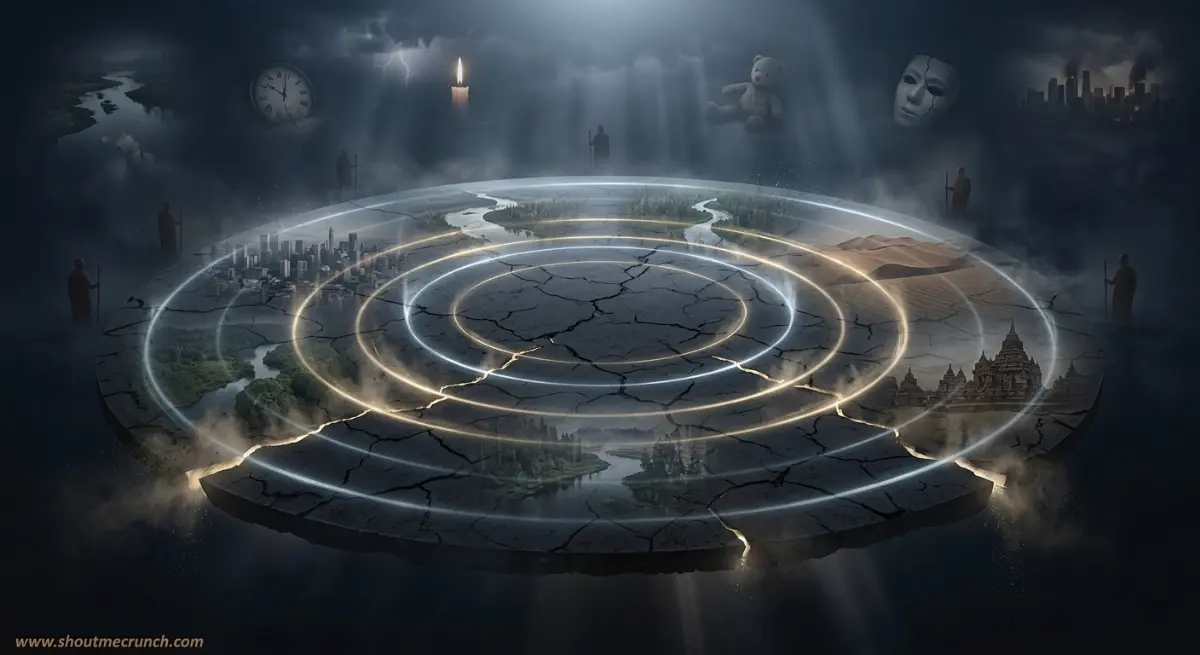
The dream said the signal moving through it was massive. That it came with an unbearable frequency.
I don’t think that means a specific earthquake or war is coming on a specific date. I think it means the pressure has been building for a long time and the monks can feel it.
What the traditions say
I’m a reader of religious texts — not a scholar, just someone who goes back to them regularly. When I placed this dream beside what I know, several passages came to mind.
The Qur’an says corruption has spread on land and sea because of what human hands have earned, and that people may taste some of what they’ve done so they might return. (30:41) It’s not a threat so much as a description of how cause and effect works at civilizational scale.
Elsewhere it warns against spreading corruption after order has been established. (7:56) The emphasis on “after order” is significant — it’s not just about destroying bad systems, it’s about what you do with a functioning one.
The Gospels describe famines, wars, earthquakes as the beginning of birth pains — not the end itself, and not something to panic over, but something to read. (Matthew 24:6–8) Warnings preceding a larger change.
The Bhagavad Gita puts it plainly: when righteousness declines and unrighteousness rises, something intervenes. (4:7–8) Whether you read that as divine or karmic, the structural point is the same.
Across different traditions, written centuries and continents apart, the pattern is consistent: moral collapse precedes visible disorder. Not as punishment from an angry deity, but as consequence from a predictable mechanism.
The warnings we’re ignoring

The dream listed a kind of taxonomy of danger. I’ll give you my interpretation.
Normalizing corruption. Not just bribery. The quiet corruption of saying something you know is false because it’s convenient. Of rewarding loyalty over competence. Of letting bad behavior slide because the person doing it is useful. These accumulate.
Short-term extraction from the natural world. Rivers, forests, fisheries, soil. Treating the earth as a balance sheet where only this quarter matters.
Treating truth as negotiable. A society that accepts “technically not a lie” as a standard for public discourse loses the ability to diagnose its own problems. You can’t fix what you can’t see clearly.
Letting families and communities hollow out. Kids raised without anyone modeling genuine care. Old people aging in isolation. Neighbors who don’t know each other. These aren’t soft concerns — they’re the substrate of everything else.
Power without accountability. In government, yes, but also in businesses, religious institutions, and families. Unchecked authority produces the same pathology at every scale.
Religion reduced to performance. Prayer and ritual that aren’t connected to how you treat people. Faith that makes you feel chosen rather than responsible. This one is painful to write because I see it and I’ve done versions of it.
Waiting until the collapse is visible before taking it seriously. By then, most of the options are gone.
What the dream was actually saying
I don’t think the monks struck the earth as an act of judgment. I think they struck it as an act of mercy.
A warning assumes you can still do something. A door you can no longer walk through doesn’t get knocked on. The signal was massive, the frequency unbearable, but the monks were still there. The earth was still carrying the message.
The most important detail in the dream was that it ended before anything collapsed. The monks had their staffs beside them. The zonal plane was trembling. And there was still time.
That’s the thing I keep coming back to. The dream wasn’t about inevitable doom. It was about a moment when people could still hear, if they chose to.
I don’t know if anyone else will read this the way I’ve written it. But I’d rather write it and be wrong about its importance than not write it and wonder later.
If this raised something for you — a text you know, an image from your own experience of this moment in history — I’d genuinely like to hear it in the comments.